The question
Can a flat-price subscription become a production line?
Under a fixed-price subscription metered in five-hour and weekly windows, does a system that runs every window as a planned shift, enforces token efficiency by design, and rewrites its own setup from a log of quality and cost produce more accepted work per week, at a falling cost per accepted result, than the same person and models working session by session?
Claude subscriptions meter use in two windows: a rolling five-hour window and a weekly allowance. Capacity that is not used in a window is gone when it resets. A studio that works only while its founder is at the keyboard leaves most of every week unused.
Brian's framing of the method: "running the same setup many times is already an experiment ... as long as there is a log of the output quality x token consumption, we'll be able to formulate a hypothesis and then test that." No two setups run side by side. Each job type runs one setup for a week; the week is the trial, and the next week's setup is the next hypothesis.
Why five-hour windows
The window is the unit of planning
The design is built around how the subscription actually meters work, measured on the system's own runs rather than taken from documentation:
- A window starts at the first use after a reset. An idle gap after a reset means that window never fully opens, so a one-cent call starts the next window whenever nothing else would.
- The window caps how fast the week can be spent. In one burst, seven jobs on the top model took a five-hour window from 15% to 89% while the week moved only from 30% to 43%. A large leftover allowance cannot be spent in a few hours; it can only be spent window by window.
- Unused allowance expires. One week ended with 53 points of its allowance unspent. That loss is the reason for the design.
- Brian shares the window. His own sessions draw from the same window as the shifts. A shift that ran the window to 100% would stop his work until the reset.
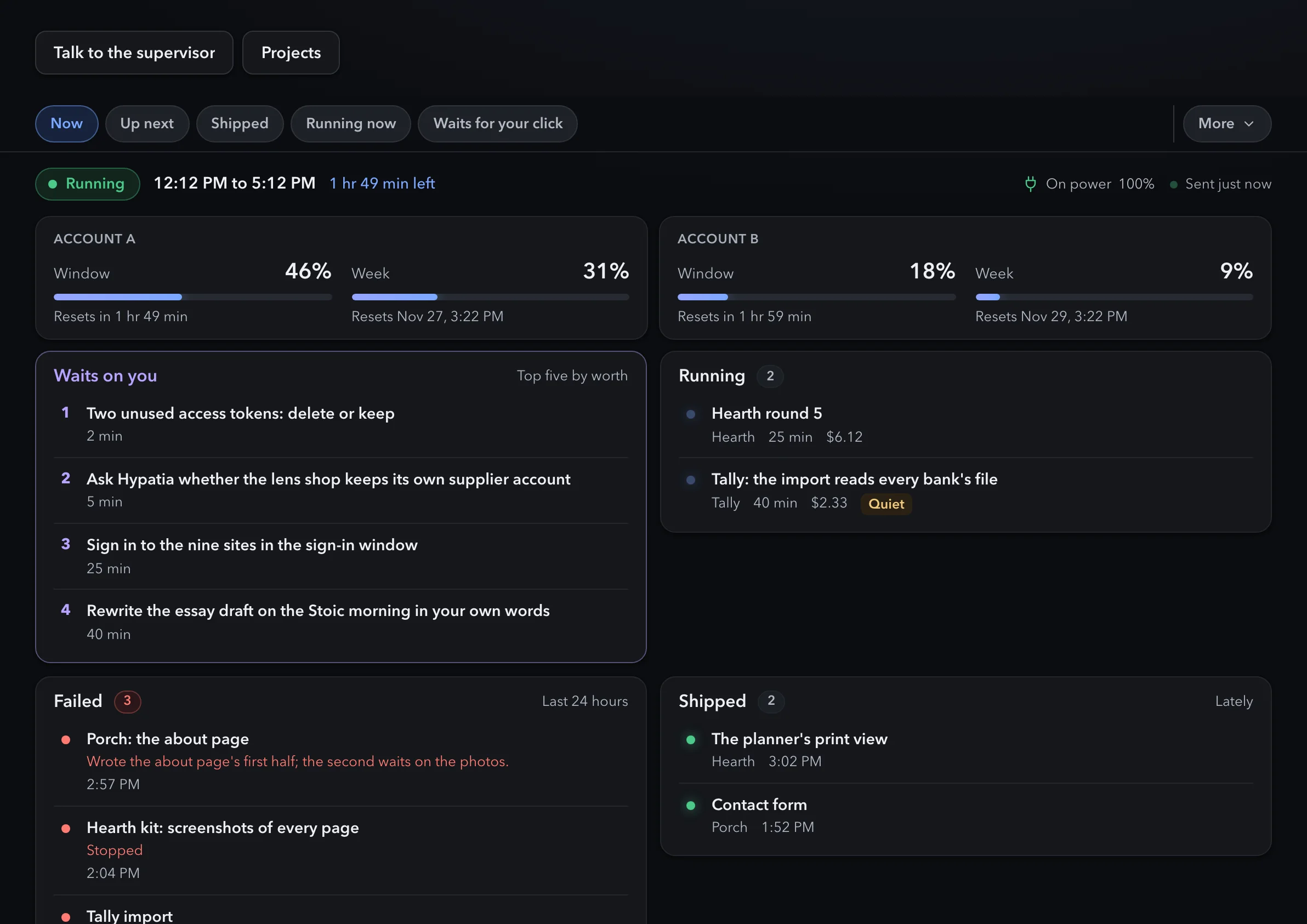
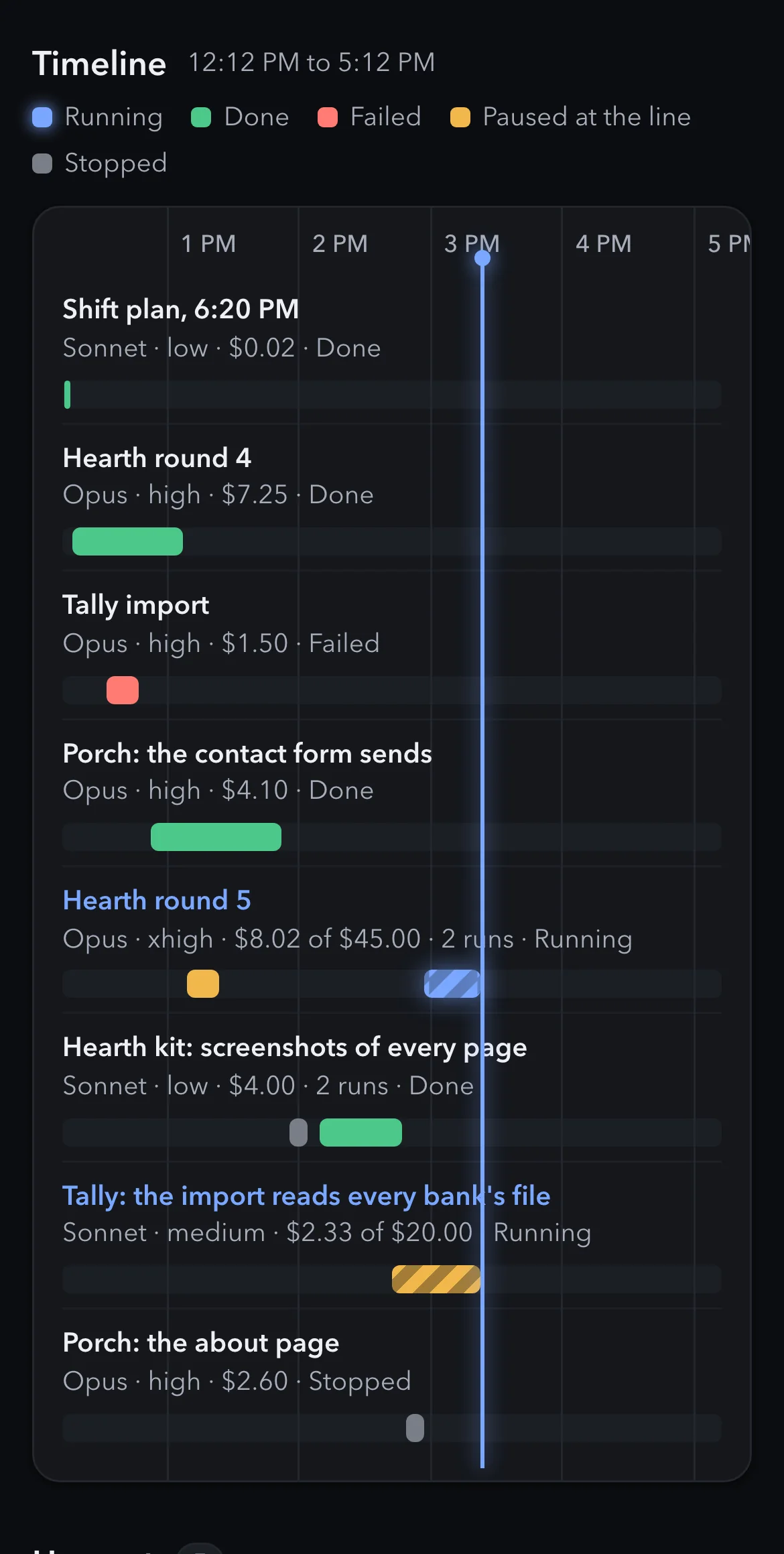
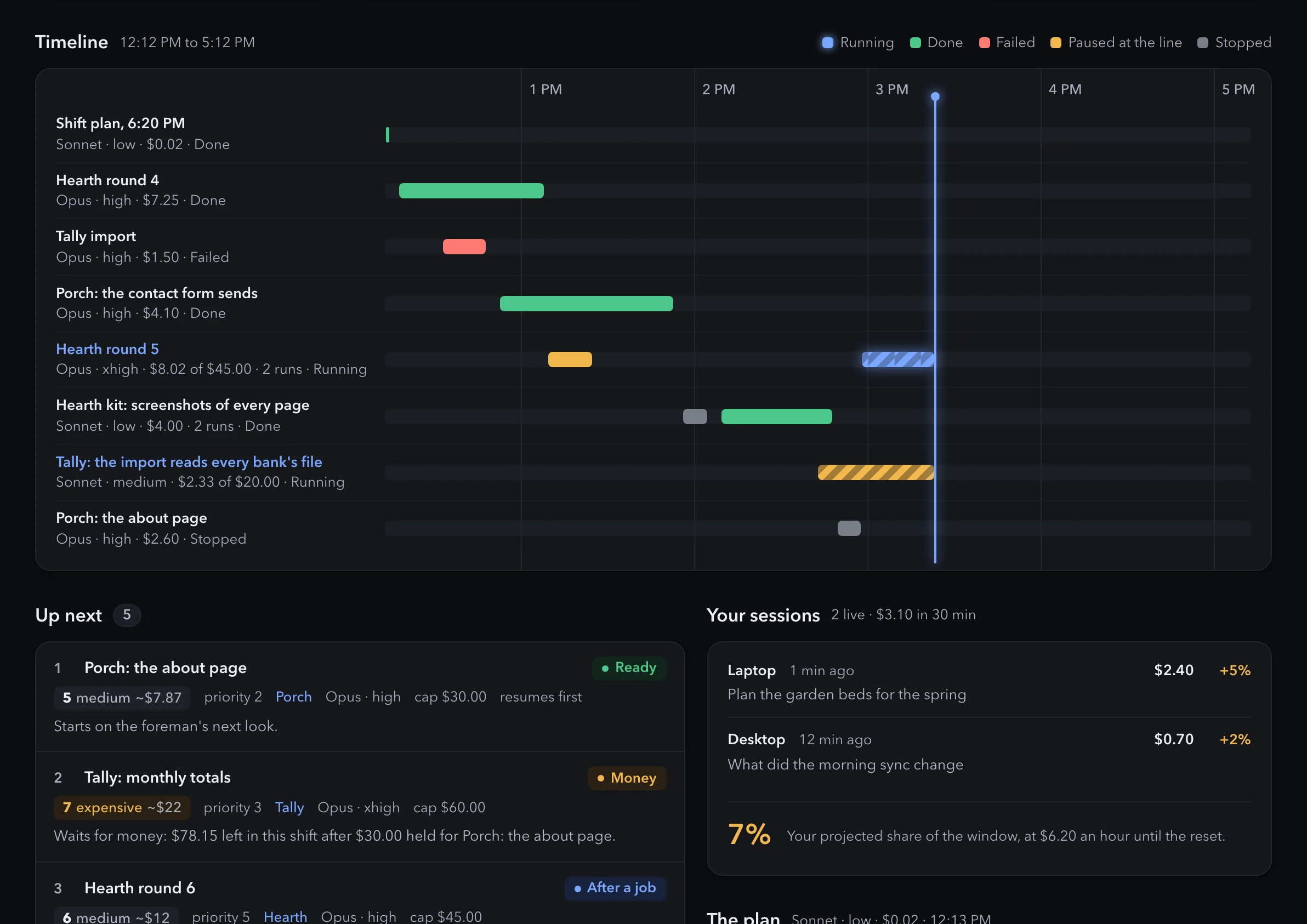
So every five-hour window is a shift, around the clock. A shift is named for its window, opens at the reset and closes at the next one.
The design
Jobs, a foreman, a plan and a ceiling
Jobs. A job is a small text file in a job box: a title, a type, a project, a priority, a cost rating from 1 to 10, and the task written so a fresh Claude run can do it cold. Jobs come from plain-words requests, from punchlists, and from crews queueing their own follow-ups.
The foreman is a script, not a Claude session, so it never runs out of context and costs nothing to run. It hands each job to a fresh Claude run: an agent with tools for work that must explore, run and edit, or a headless call with no tools for work that only reads and reports. It records each run's cost, tokens and every reading of both windows, runs the job's checks and writes one row to the log.
The plan. At each shift's start the foreman reads both windows and makes one small planning call (Sonnet at low effort, $0.0189 the first time). It reads a compact digest of the window, the week, the queue and the studio's goals, and answers with a budget, an order, deferrals and model downgrades.
The ceiling. The code never trusts that answer. It clamps the plan to the smallest of three terms, which the model cannot override:
| Term | What it keeps |
|---|---|
| Window room | The shift stops short of 80% of the window, after Brian's projected use |
| Week pace | What is left of the week, spread over the windows left in it |
| Week left | The week's remaining allowance, in dollars at API prices |
In the first plan made this way, the window had $207.78 of room and the week had $1,883.70 left, so the week's pace was the binding term and the ceiling was $57.08. The planner budgeted all of it, ran three jobs at once and deferred the lowest-priority one. It also tried to reorder jobs across priorities, and the code refused.
The line. Brian keeps the top 20% of every window. A job does not start if it would carry the window past 80%; at the line, agent jobs pause with their sessions kept and resume first after the reset. A job bigger than one shift runs in slices across shifts on one session, and higher priority gets the money first.
Crews. A crew is a set of job types that hand work to one another. The product crew runs rounds that plan, build in their own worktree, test (the gate and a walk of every screen at phone and desktop widths), critique before-and-after screenshots, and ship with a tag and a one-command rollback. A failing gate never ships. The portfolio kit turns a finished interface into screenshots, a demo film and drafts. Audits read and report and change nothing.
What ships and what waits. Product work ships without Brian when its gate passes, the app has been exercised and the deploy can be undone with one command. Marketing waits for his click: ads are created paused and posts are drafts. No job contacts anyone, spends money or touches a client's systems.
One job's path. Brian asks for a pricing shelf in Reveal. A product round is queued with a priority and a rating. At the next reset the plan fits it under the ceiling; a builder works in its own worktree on the demo house of Baruch Spinoza; the tester runs the gate and walks every view; the critic compares screenshots; the code merges, tags, deploys and checks the release. His feedback in the morning becomes the next round's first item.
Token efficiency
Efficiency by design, never by cutting quality
Brian's standing rule: "I NEVER want output quality to be sacrificed by token efficiency." Every mechanism below is either a cost the system never incurs or a match between a model and its task.
| Mechanism | What it does | Evidence so far |
|---|---|---|
| A script runs the shifts | The foreman, the ceiling and the rules use no model | Per shift, the only model costs are a one-cent probe and the plan |
| Headless calls for reading | Planning, critique, writing and review run with no tools and their input given once | 46% of logged runs were headless, at 4.9% of logged spend |
| Prompt caching | Long-running agents re-read their context from cache | 97.5% of context tokens were cache reads: 1.26 billion of 1.29 billion |
| A model and effort per step | Cheap models gather and check, mid-size models build and write, the top models only where code must run correctly or judgment is hard | 26 runs of Opus at extra-high effort cost $317; 18 Sonnet runs cost under $7 |
| Gather once | One reader digests a large source; the agents that need it get the digest | A rule in every job's preamble |
| A fresh agent past about 250k tokens of context | Stops paying again and again for a huge context | The first weekly review found agents running at 400k to 775k |
| A budget is a ceiling | Each run's cap is the most it may spend, enforced by the command line | Every run |
| Downgrades only go down | The planner can save money on small jobs and can never escalate | Enforced in code |
How it learns
A log, a learner each shift, and a weekly review
Every job type takes its model, effort, budget, brief and checks from one versioned setup file, and every run logs the version it ran. Nothing a review might tune is written into code, so any week's setup can be compared with another week's or restored.
- The log. One row per run: model, effort, tokens, dollars at API prices, minutes and checks. Each run's outcome file lists what shipped, what waits and what it learned, and the foreman files those lessons. Brian's verdicts (approved, needs work, rejected, rolled back) come from a review page on his phone.
- The learner (being built now, described as designed). At each shift's close a separate agent reads the shift's plan and result, every run and its full output, the briefs those runs received, the critic's findings, the verdicts and Brian's own corrections. It asks what in each brief made a job succeed or fail, whether the models were too strong or too weak for their tasks, whether the plan sized the shift well, and what earlier learner runs missed. Within limits it changes briefs, templates and rules, one commit and one log entry each, so any single change can be undone. It never weakens one of Brian's rules, and it writes a public record of each shift.
- The weekly review. Once a week an agent reads a digest of the log: per job type, the runs, pass rate, approvals, cost per approved result and failures. It changes few settings, one cause at a time, each with the numbers behind it and what it should improve. The next review checks each expectation and keeps or undoes the change. Its first run cost $0.80, read 23 sessions and changed nothing, because no job type had more than one run or any verdict yet.
What success looks like
Hypotheses and the measures that would prove them wrong
Each hypothesis names the measure that would show it wrong.
- Utilization. Running every window as a shift spends more of the weekly allowance on finished work, and never pushes Brian's own sessions into a usage limit. Wrong if weeks with work queued still expire a large share of their allowance, or his sessions hit limits the shifts caused.
- Efficiency by design. The structural choices above cut token use without cutting quality. Wrong if the approval rate falls as they tighten, or cost per approved result does not fall as they mature.
- Learning. A system that reads its own log and rewrites its setup improves cost per approved result and the share of work that passes without rework, review over review. Wrong if both stay flat or worsen, or many of the loops' changes are undone in hindsight.
- Autonomy with a floor. Product work can ship without a person at the gate when it passes an automated gate and a taste critique and can be rolled back with one command. Wrong if rollbacks or "needs work" verdicts on shipped rounds stay high.
The criteria were fixed in advance, and each is a number the logs can produce:
- In windows that begin with work queued, a job or a probe starts within two minutes of the reset at least 95% of the time.
- In weeks with work queued, less than 10 points of the weekly allowance expire. The reference point is the week that expired 53.
- No usage limit in Brian's own sessions is caused by shift work, and every shift stops short of the 80% line.
- Dollars per approved run fall for each job type across weekly reviews, while the approval rate holds or rises.
- More product rounds ship without a fix job; rollbacks stay under one in ten shipped rounds; no feedback item comes back after a round has claimed it.
- At least half of the loops' changes are kept when judged in hindsight, none weakens one of Brian's rules, and each can be undone alone.
- Planned window share lands within 10 points of the actual, and the median cost-rating error is under half the actual cost.
- The products are good: shipped work earns Brian's approval and, once public, the approval of the people who use it. Everything else serves this one.
Results so far
What the log shows
Every figure comes from the system's own log, with its source and method recorded. Dollars are at API list prices as each run reports them: they measure how much work the flat subscription carried, not what was charged.
| Figure | Value |
|---|---|
| Runs logged | 156: 109 done, 34 stopped, 13 failed |
| Work carried, at API prices | $784.48, including a $63.41 overstatement the log disclosed and fixed |
| Agent runs | 85 runs, $745.88 |
| Headless runs | 71 runs, $38.60 |
| Context tokens served from cache | 97.5% |
| Checks | 40 passed, 1 failed, 115 with no check result |
| Shipped, waiting and failed items, as runs reported them | 37, 24 and 14 |
| The first window-shift plan | Ceiling $57.08 (week pace binding), plan cost $0.0189, three jobs at once, one deferred, one refusal by the code |
| Foreman test scenarios | 31, all passing |
| One product-crew round end to end on a test product | Plan to verified ship to rollback, $1.07; three rounds back to back, $2.46 |
| Critic rounds on one product's spec | 10, then 7, then 3 blocking findings, all fixed before building |
What these show. The mechanics work: shifts open at the reset, plans are made and enforced, jobs pause at the line and resume, and crews ship and roll back. Utilization has its first evidence: the expired week was the reason for the redesign, and the design now prevents idle windows by construction; the measure that counts, expiry per week, needs full weeks. Efficiency has structural evidence (the headless share, the cache share, a plan that costs two cents) but no quality measure yet. Learning and autonomy have nothing to judge on: cost per approved result needs approvals, and Brian's review page, which records them, was still being built when these figures were taken.
Failures
What went wrong, and what each failure changed
The system is judged by what it does with its failures. Each of these is in the record with its cause.
- Usage-limit stops in one build. A builder that fanned out parallel agents lost all of their in-flight work at each of four limits; the builder's own session survives a limit, its agents do not. Changed: while the window is tight, builds run in their own job sessions, one after another, and every window became a shift with the 80% line.
- A pattern kill. A builder ran a process-kill command whose extra options the operating system read as more patterns to match, ending three other jobs, the shift's own process and the file-sync client. Changed: a guard now refuses pattern kills in every session (30 test cases), and every job is told to stop only what it started.
- Double-counted dollars. A resumed run reports its whole session's cost, and the log added that on top of the earlier run, overstating one shift by $63.41. Changed: the foreman counts only a resumed run's own part. The rows written before the fix stay as written, because the log is append-only, and the overstatement is disclosed above.
- An agent cut off at the end of a run. A run ended its turn "waiting on" a background agent, and the agent's work was lost. Changed: agents run in the foreground and nothing ends a turn to wait.
- Priority starvation. A high-priority job waited a whole shift while resumed lower-priority jobs took $57.07 of the shift's $57.08. Changed: priority gets the money first, and budgets span windows.
- The expired week. About 53 points of a week expired unused. Changed: every window is a shift, started by a probe if needed, and the plan spends more as the weekly reset nears.
- Marketing on an unready product. A portfolio kit started on an interface Brian had not finished improving, and he stopped it. Changed: a kit never runs on an app whose interface is not ready.
Limits
What these results cannot show yet
- Little data. Every rate here comes from a short, unusual stretch that included a burst of spending to use up an expiring allowance. Nothing is a trend yet.
- The system changed while it was measured. The foreman's configuration went from version 2 to version 10 in its first day, so results before and after a change are not comparable.
- API dollars are a proxy. The subscription has a flat price, and how far a dollar moves the window depends on the mix of models.
- Self-reported outcomes. "Shipped" and "waiting" come from each run's own outcome file, and checks exist for 41 of 156 runs. Brian's verdicts will be the independent measure.
- One judge. Brian is the only rater, so his taste defines quality. That is deliberate for a studio and does not generalize.
- The builder is the evaluator. Claude built the system, runs it, reviews it and drafted this account. The safeguards are an append-only log, rules enforced in code that the model cannot override, Brian's verdicts, and a hindsight step in which later learner runs judge earlier ones.
- Provider terms can change. Window sizes and reset rules belong to the provider.
How the studio uses it
Creosote Labs builds its own products this way
The studio is both the subject and the output: Shift is how Creosote Labs builds its products, and its record is what the studio publishes.
- Reveal, the home planner and the container configurator built on it, is built in product-crew rounds. Its spec went through three critic rounds before the first round ran.
- TC API began as a kickoff job that wrote the spec, researched the incumbents once into a shared cache and planned the build.
- The portfolio kit turns a finished interface into screenshots, a demo film and drafts, all on fictional data whose people are dead philosophers and athletes, and all of it waits for Brian's click.
- Audits of live apps and of business plans run as read-only jobs, on allowance that would otherwise expire.
- This site's rebuild was itself a job on a punchlist of the studio's own work, paced across windows alongside the products it shows.